
01 · Department
Chemical analysis of metals, alloys and materials
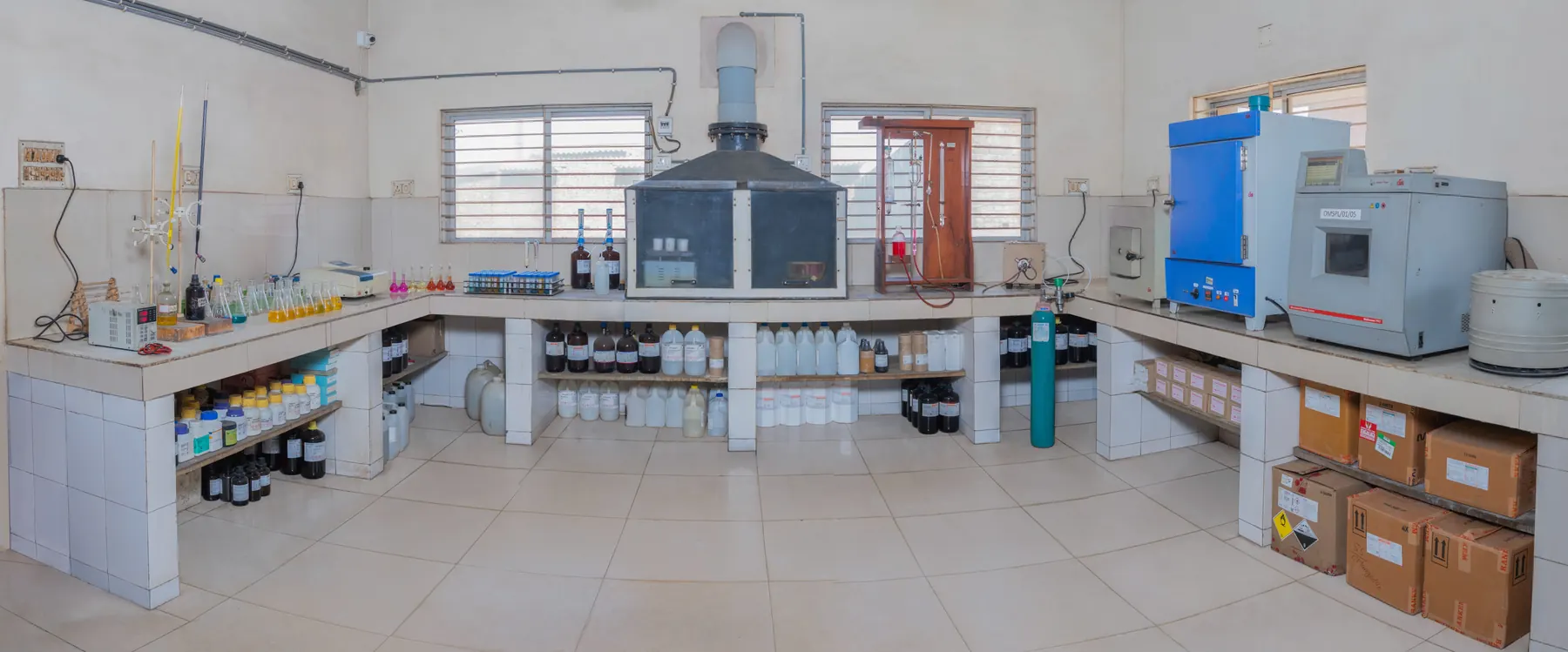
The chemical department of Divine Metallurgical Services Private Limited, in Odhav, Ahmedabad, finds out what a metal, alloy or material is made of.
Three spark spectrometers cover seven base metals, and ICP-OES measures trace elements down to parts per million.


Test groups
All 27 chemical tests, by technique
Open a group to see every test in it and what each test shows.
Spark OES analysis
9 testsSpark optical emission spectrometry gives the full composition of a solid metal sample. It confirms the grade of steels, cast irons and non-ferrous alloys against a specification or a drawing.
- Used for
- Steel, cast iron, stainless steel, aluminium, copper, nickel, titanium, cobalt and zinc alloys
Tests
- Iron-base alloys: steels and cast irons
Full chemical composition of carbon steel, alloy steel, stainless steel, tool steel and cast iron by spark OES. It confirms the grade of a casting, forging, plate, bar or pipe against its specification.
- Aluminium-base alloys
Chemical analysis of aluminium alloys by spark OES, for castings, extrusions, sheet and ingots. It confirms the alloy grade and checks the impurity elements.
- Copper-base alloys
Chemical analysis of copper, brass, bronze, gunmetal and other copper alloys by spark OES. It confirms the grade of castings, rods, tubes and fittings.
- Nickel-base alloys
Chemical analysis of nickel alloys and superalloys by spark OES. It confirms the grade of heat-resistant and corrosion-resistant parts, bars, plates and castings.
- Titanium-base alloys
Chemical analysis of commercially pure titanium and titanium alloys by spark OES, for bars, plates, forgings and tubes.
- Cobalt-base alloys
Chemical analysis of cobalt alloys by spark OES, including wear-resistant hardfacing alloys and heat-resistant castings.
- Zinc-base alloys
Chemical analysis of zinc and zinc die-casting alloys by spark OES. It confirms the grade of ingots and die castings and checks harmful impurities.
- Metal purity check: aluminium, copper, nickel, titanium and zinc
Purity of aluminium, copper, nickel, titanium and zinc metal, found by measuring the impurity elements. Ordered for ingots, cathodes, anodes and other raw material.
- Ferrite content from chemical composition
Ferrite content of austenitic and duplex stainless steel weld metal and castings, calculated from the chemical analysis.
ICP-OES and trace elements
6 testsICP-OES measures elements down to parts per million in metals, alloys, high-purity metals and solutions. It handles chips and wire that cannot be sparked, and precious metals that need a purity check.
- Used for
- High-purity metals, precious metals, chips, wire, plating and process solutions
Tests
- Element analysis of metals and alloys
Chemical analysis of metals and alloys by ICP-OES, from major alloying elements down to trace levels. It suits chips, drillings, wire, powder and small parts that cannot be sparked.
- Special elements: scandium, gallium, selenium, strontium, yttrium and others
Analysis of less common elements such as scandium, gallium, selenium, strontium and yttrium in metals and alloys, by ICP-OES.
- Precious and platinum group elements
Gold, silver, platinum, palladium, rhodium and other platinum group elements measured in alloys, platings and process solutions.
- Purity check: lead, tin, magnesium, silicon, cadmium and selenium
Purity of lead, tin, magnesium, silicon, cadmium and selenium, found by measuring trace impurities by ICP-OES. Ordered for ingots, solders, anodes and raw materials.
- Gold, silver and platinum group metals: purity and full analysis
Purity and full analysis of gold, silver, platinum, palladium and other precious metals. Ordered for refined metal, precious metal alloys and recovered material.
- Metal concentration in liquid samples
Concentration of dissolved metals in plating baths, pickling liquors, process solutions and other liquid samples, by ICP-OES.
WD-XRF analysis
3 testsWavelength-dispersive X-ray fluorescence analyses materials that are hard to dissolve or spark: ferro alloys, metal oxides, ceramics and refractories.
- Used for
- Ferro alloys, oxides, minerals, ceramics and refractories
Tests
- Ferro alloys
Chemical analysis of ferro alloys such as ferro silicon, ferro manganese, ferro chrome and silico manganese by WD-XRF. It checks the grade before the alloy goes into the furnace.
- Metal oxides
Chemical composition of metal oxides and minerals by WD-XRF, reported as oxides. Ordered for raw materials and process by-products.
- Ceramics and refractories
Chemical analysis of ceramics and refractories by WD-XRF, such as fire bricks, castables and ramming mass. It reports alumina, silica and the other oxides that decide how a lining performs.
Classical wet chemistry
5 testsThe lab keeps a classical wet chemistry section as the reference when results are disputed. Carbon and sulphur, single elements, loss on ignition and plating identification are done here.
- Used for
- Metals, alloys, platings, powders and process materials
Tests
- Carbon and sulphur by combustion
Carbon and sulphur content of steels, cast irons, ferro alloys and other metals by combustion analysis. Used where low carbon or sulphur limits must be proved.
- Element analysis by wet chemistry
Classical wet chemical analysis of single elements in metals, alloys and raw materials, by gravimetric and titration methods. It is the reference when instrument results are disputed.
- Loss on ignition
Loss on ignition (LOI) of refractories, minerals, oxides, powders and fluxes. It shows the moisture, carbonates and other volatile matter in a material.
- Moisture content
Moisture content of powders, fluxes, minerals, ferro alloys and other raw materials, checked on receipt or before use.
- Plating identification
Identifies the metal of a plating or coating on a part, such as zinc, nickel, chromium, tin, cadmium, silver or gold.
Chemicals, compounds and pharma samples
4 testsThe same instruments identify unknown chemicals and compounds, check assay and purity, and measure restricted heavy metals for pharma samples and RoHS checks.
- Used for
- Industrial chemicals, compounds, pharma samples and components for RoHS checks
Tests
- Known and unknown chemicals and compounds
Identification and elemental analysis of known and unknown chemicals, salts and compounds, to find what a material is or to confirm its composition.
- Assay and purity of chemicals
Assay and purity of industrial chemicals, metal salts and compounds, checked against the supplier’s specification or a purchase requirement.
- Elemental impurities in pharma samples
Heavy metals and other elemental impurities measured in pharmaceutical raw materials, intermediates and finished products.
- Restricted elements: lead, arsenic, cadmium, mercury and hexavalent chromium
Lead, arsenic, cadmium, mercury and hexavalent chromium measured in metals, platings and components, for RoHS and other restricted-substance checks.
Instruments
Instruments in the chemical department
- Three vacuum spark OES
- ICP-OES
- WD-XRF
- Microwave digester
- Carbon and sulphur apparatus
- UV-visible spectrophotometer
- Ultra-pure water system
Departments
Other departments and services
Enquiry
Send an enquiry to the laboratory
Tell the laboratory what you need tested.